
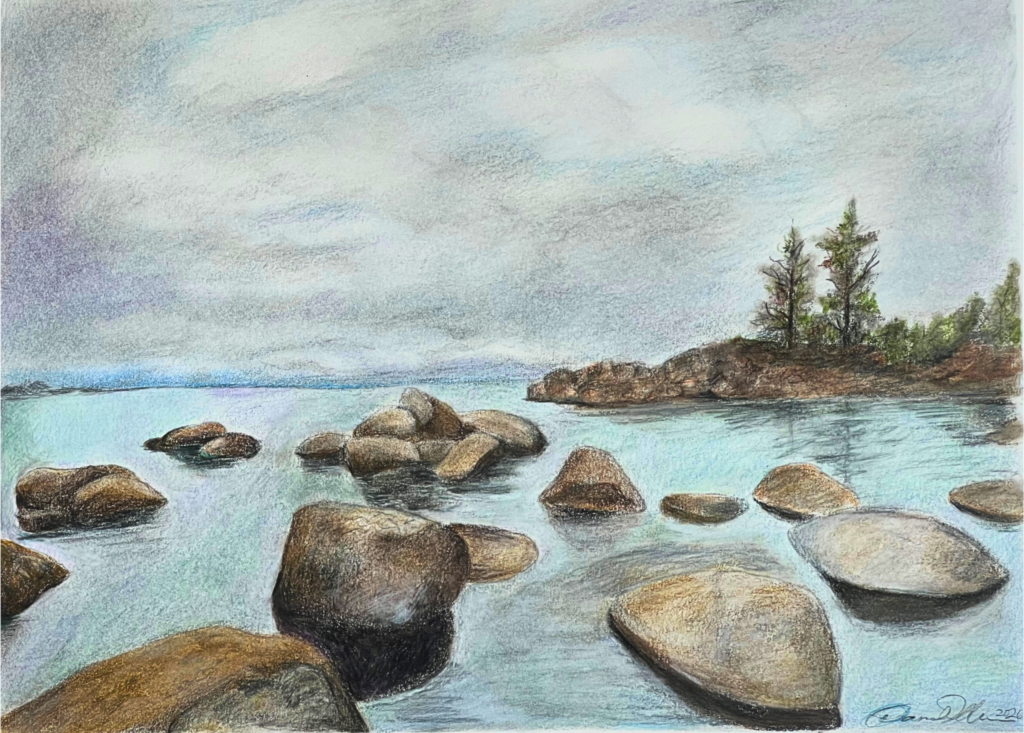
Colored pencil is a quiet medium. It doesn’t reward rushing, and it doesn’t pretend that speed equals skill. It rewards something else entirely- time. Real time. The kind you can’t pretend to know. It is layer after layer, gentle decisions, small corrections, and long stretches of simply staying with what’s in front of you.
I used to treat slowness like a problem I needed to solve. But over time, it’s become one of the quiet gifts of this medium. When I work slowly by layering, adjusting, and returning, I drop into a steadier state of mind. The repetition becomes rhythmic. The small decisions pull my attention back into the present. Slowness stops feeling like “delay” and starts feeling meditative and a way of listening, of softening, of letting the image arrive in its own time.
If you want richness, you can’t muscle your way there in ten minutes. If you want a soft glow, you can’t jump to the final layer. Most of what makes colored pencil feel alive is the accumulation of many light passes. This is achieved with pressure control, shifting direction, adjusting temperature, and building value gradually so the paper still has breath. It feels like colored pencil has been teaching me that I have to earn my image.
My “patience moments”
There are a few stages where I feel impatience most strongly—because they ask for repetition and restraint.
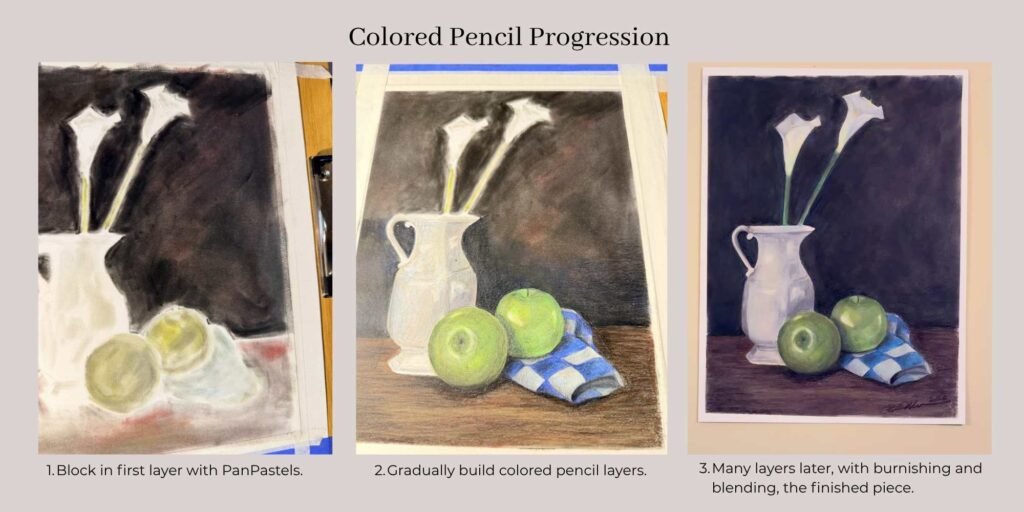
- Layering: The early layers can look unimpressive. They are faint, grainy, almost like nothing is happening. This is where the drawing asks for trust. Each light pass is laying down information your eye will feel later, even if you can’t fully see it yet.
- Burnishing (or gentle blending): This can be satisfying, but it also asks for timing. Too early and everything flattens; too late and the paper can feel tired. It’s a practice in listening: Is this ready, or am I trying to force “finished”?
- Reworking: Colored pencil invites revision. A passage might need to be warmed, cooled, softened, or clarified. Reworking is where pride can flare up—I already did this—and where patience becomes emotional, not just technical.
What I practice while I layer
Most days, patience looks less like a virtue and more like a set of tiny studio choices:
- Attention: returning to the same small area and really seeing what it needs (not what I wish it would do).
- Acceptance: allowing an “in-between” stage to exist without labeling it as failure.
- Listening: letting the drawing guide the pace—light pressure when the paper needs it, a pause when I’m pushing too hard.
Sometimes I notice I’m rushing because I’m trying to get away from uncertainty. If I can slow down and stay present, the drawing usually gives me the next step. Or simply taking a break and coming back helps.
Patience isn’t delay, it’s part of the image
When I’m working slowly, I’m not “behind.” I’m building a kind of quiet structure that holds the final piece. The softness of fur, the glow in a sky, the gentle turn of a form. Those aren’t just effects, they’re the evidence of time spent paying attention.
Colored pencil has taught me that patience isn’t what happens before the art. Patience is one of the materials. It’s part of the medium. For me it is just as real as the paper, pigment, and light.